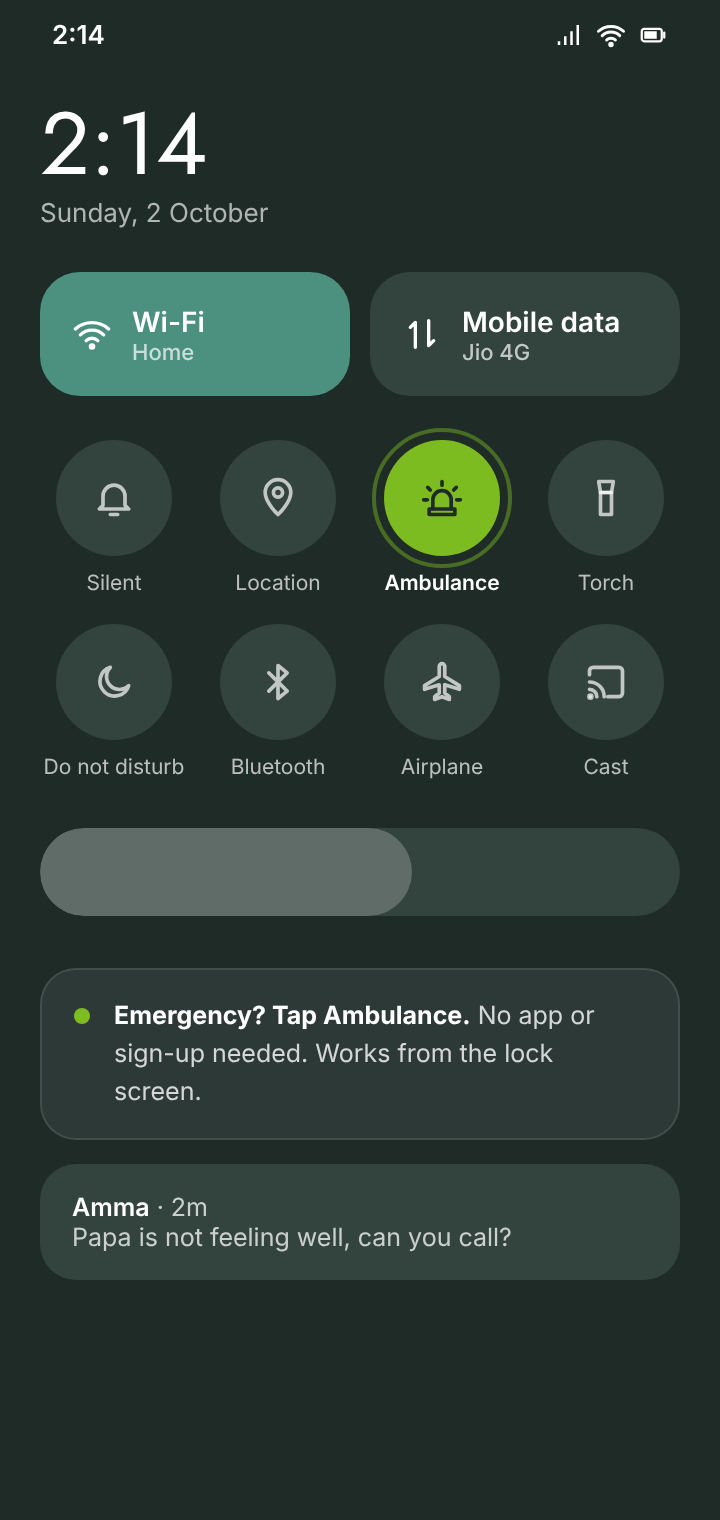
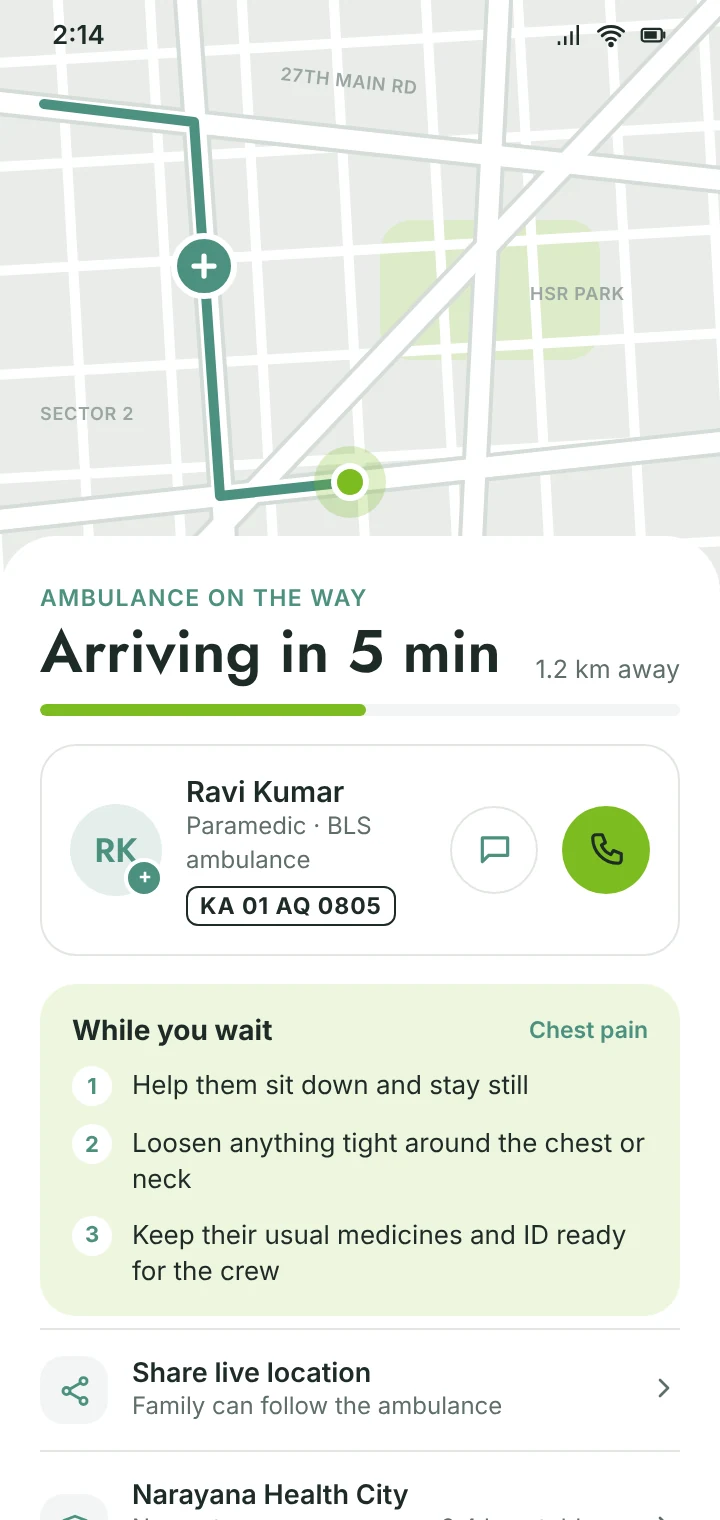
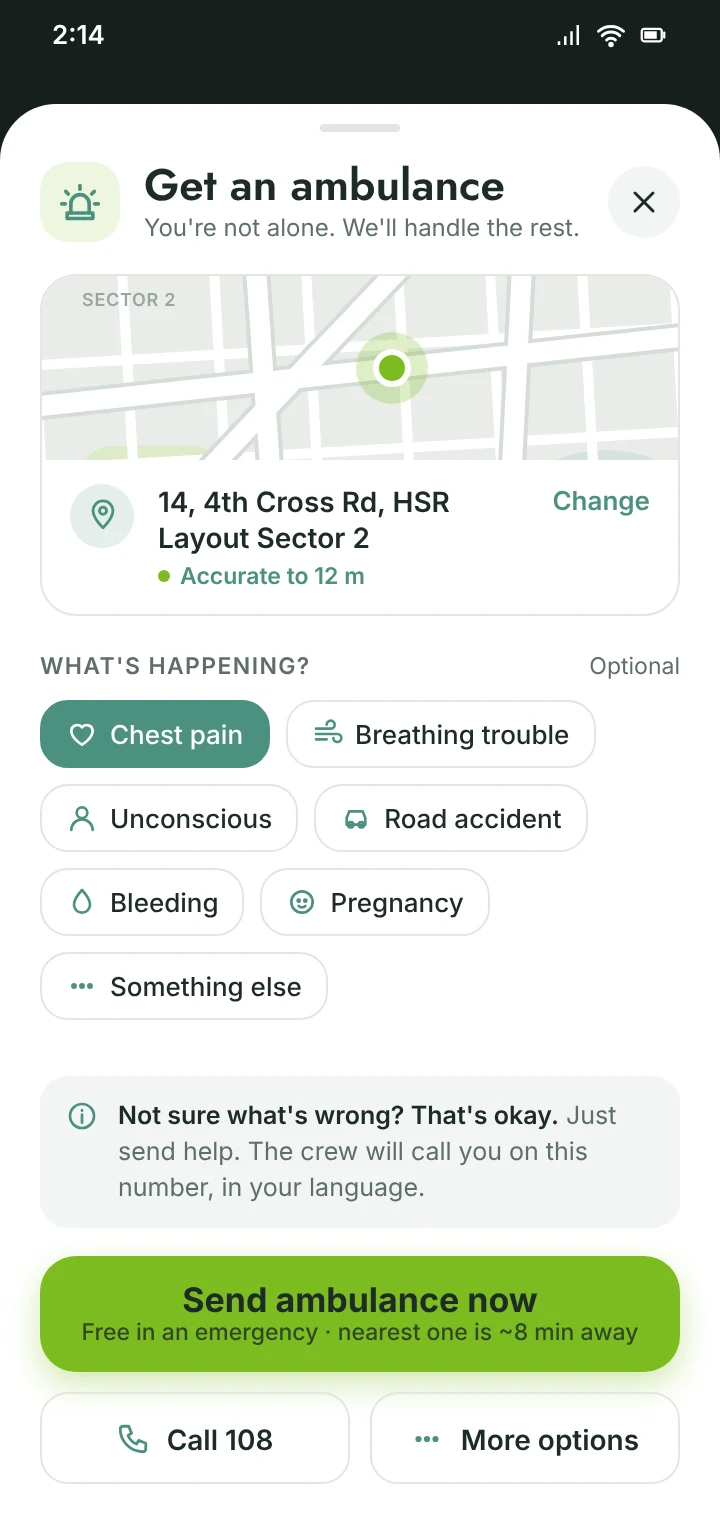
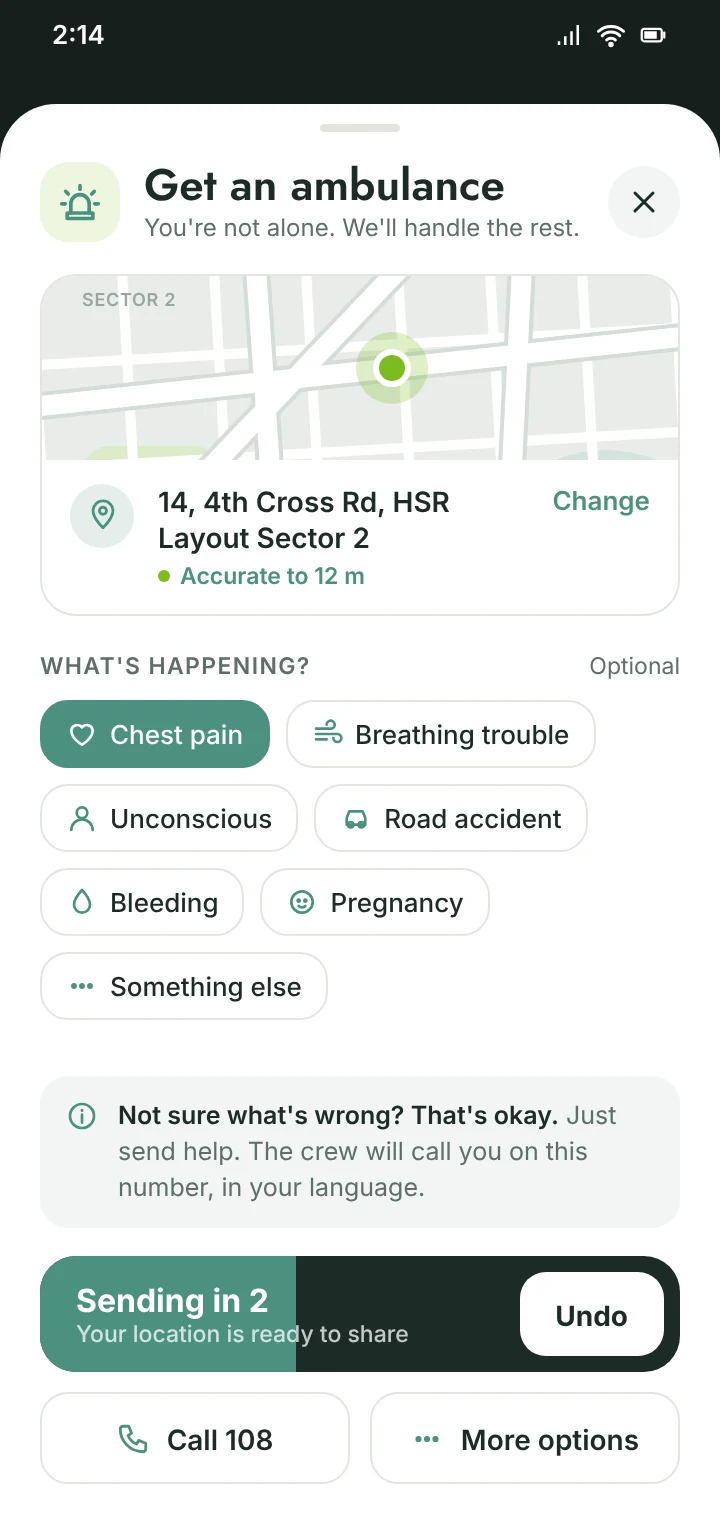
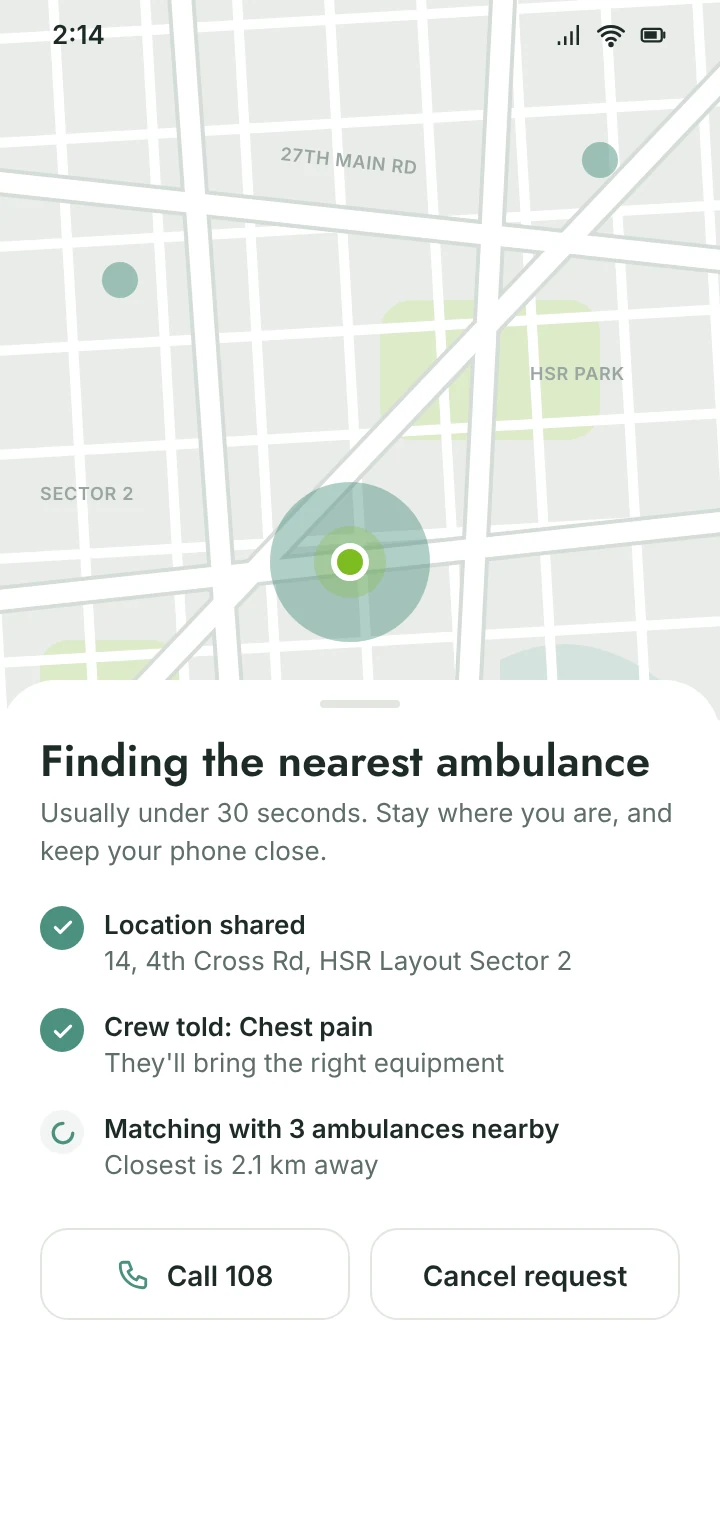
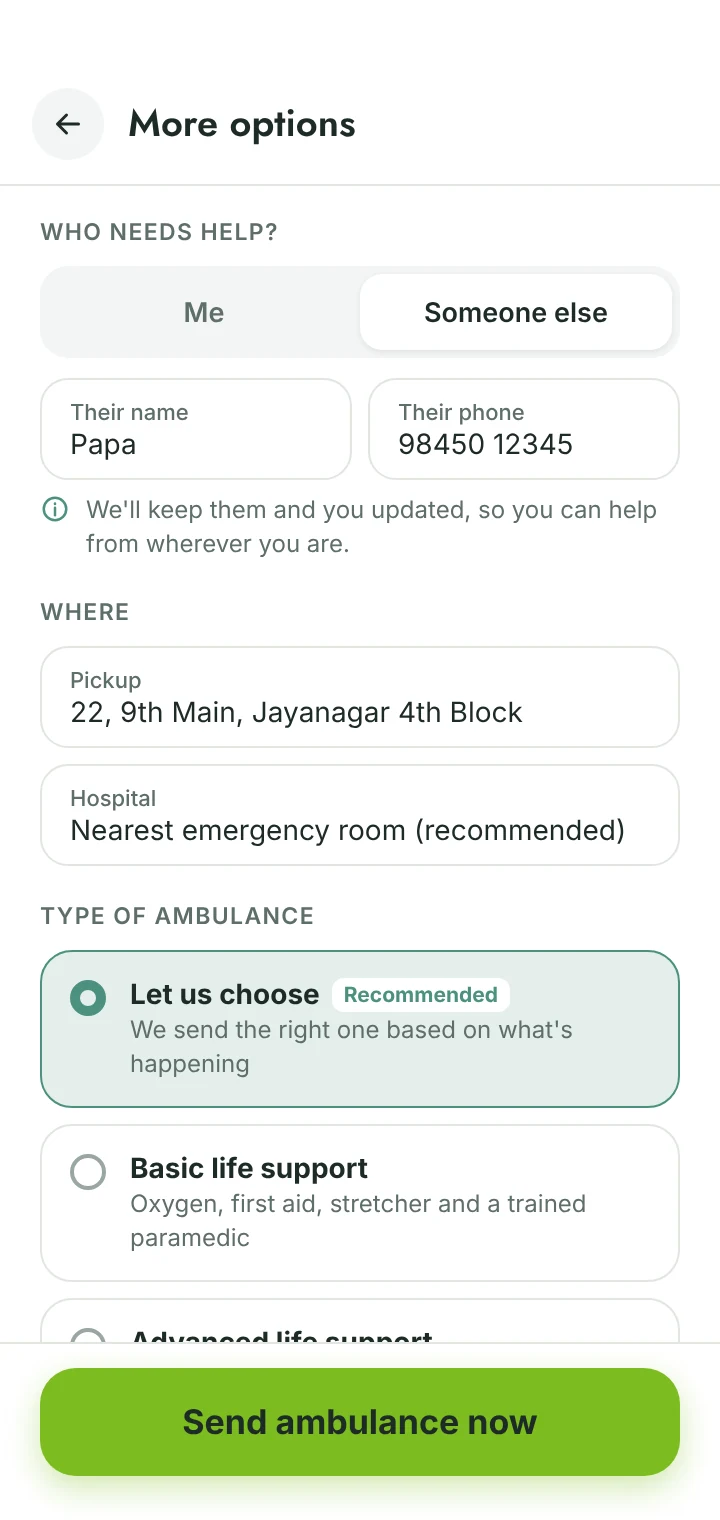
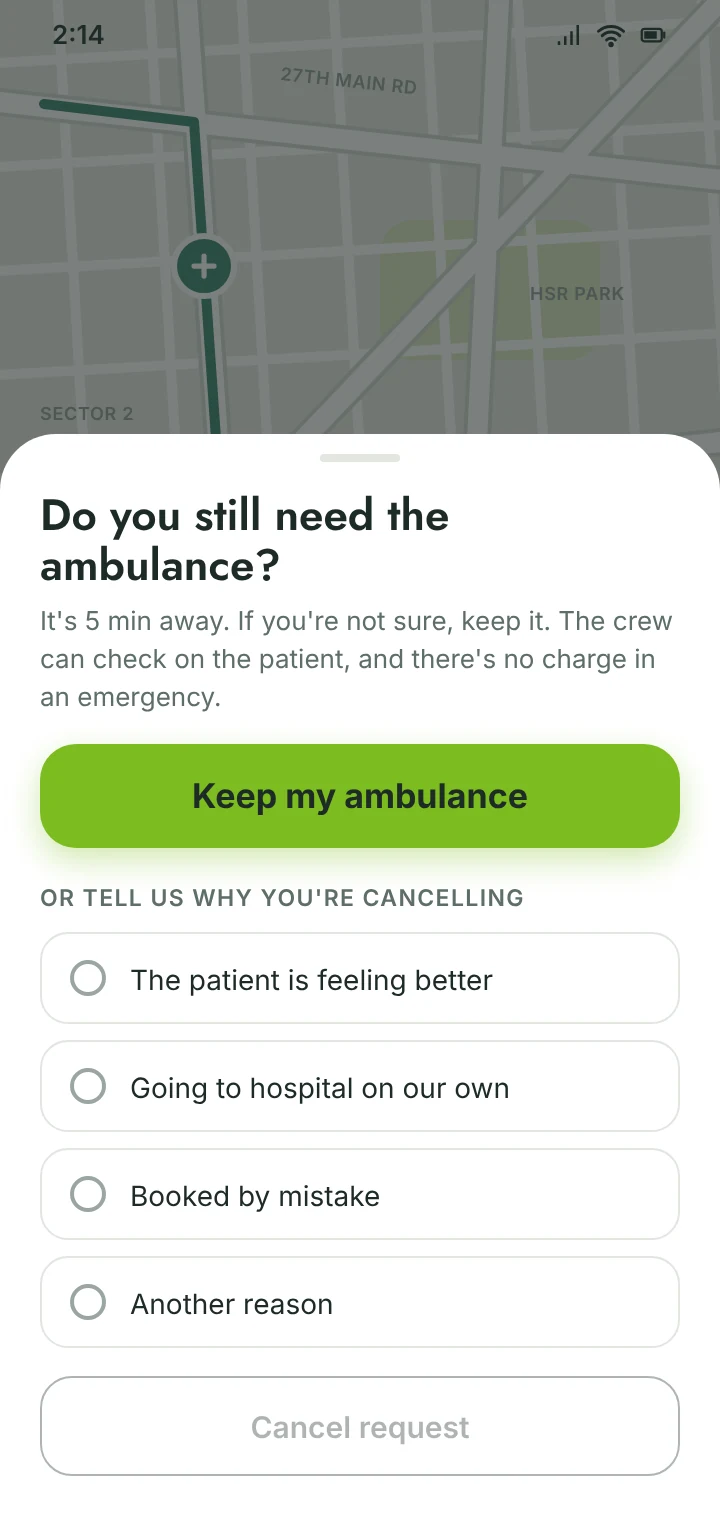
This is the real flow, working in your browser. Tap Ambulance in quick settings, pick what’s happening, and follow the ambulance to your door. You can also try Undo, Cancel and More options.
What changed from my first version of the UI
“Book”, with no context→“Send ambulance now”, with the cost (free) and arrival time on the button
Location as a small grey label→Full address, how accurate it is, and a Change link
Road accident or Household→An optional “What’s happening?” that briefs the crew and gives first-aid tips
A cab-style driver card with a trip count→The named paramedic, the ambulance type and the plate
Cancel reasons, straight away→“Keep my ambulance” comes first, with kind words if you still cancel
No safety net→A three-second Undo, Call 108 on every screen, and a live link for family
Blue buttons and 8px grey text→The three case-study colours, and nothing smaller than 12px
Overview
Booking an ambulance shouldn't be harder than booking a cab.
The problem
In India, people struggle to reach an ambulance quickly in an emergency. Helplines get overloaded, callers have to describe locations out loud, and families have no idea when help will arrive.
The solution
An ambulance tile in the phone's quick settings. One tap shares GPS location, books the nearest ambulance and shows live ETA, with no download, sign-up or login.
The goal
Cut the time it takes to request help and find the patient, reduce missed calls, and lower anxiety by keeping families informed until the ambulance arrives.
Design process
01
Research
Brainstorming · Secondary research · Competitor analysis · Journey map · Hypothesis · 20 user interviews
02
Synthesis
Affinity mapping · Insights · How might we · Design brief
03
Ideation
Solution space · Personas · STP analysis · Feasibility · Stakeholders
04
Execution
Information architecture · Brand identity · Style guide · Interface
01 · Research · The problem in numbers
India's emergency response can't keep up with demand.
28%
of emergency calls to CATS in New Delhi are missed because no ambulance is available.
Out of every 25 calls, 7 go unanswered.
19 / hour
road deaths in India. 1.6 lakh people died in road crashes in 2023, with 53 crashes every hour. Many could be saved by care within the golden hour.
7.5 min
Urban response (UP)
30+ min
Rural response
Response times depend heavily on where you live. Demand also peaks at night: CATS handles 178 calls an hour, rising sharply between 8 PM and 12 AM.
Sources: Report of the Working Group on emergency medical services; Scroll.in; Hindustan Times; Med Cab. Figures as collected during secondary research.
01 · Research · Secondary research
About 28,000 free emergency ambulances for 1.4 billion people.
That is one government-run 108 or 102 ambulance for every 50,000 people, and the fleet is spread very unevenly across states. Private ambulances add more, but they charge, and there is no single reliable count of them.
Scroll to build the picture ↓
Ambulances by state
State / UT
Free emergency ambulances NHM: 108, 102 and similar, 2021
Other government ambulances At PHCs, CHCs and hospitals, 2021
Private vehicles used as ambulances Commercial permits, Mar 2019
Sources: Randhawa & Nandraj, “Ambulance Services in India: Are the Sirens Loud Enough?”, Indian Journal of Preventive and Social Medicine 53(4), 2022, Table 2 (NHM and state data, 2021; MoRTH Road Transport Year Book, 2019). The authors note that state figures are reported inconsistently and the columns overlap, so they should not be added together. A dash means the figure was not reported. The latest national count is 15,283 basic, 3,044 advanced and 3,918 patient-transport ambulances under the National Ambulance Service, as of June 2024 (PIB, 11 Mar 2025). State-wise figures for 2024 have not been published. Per-person figures use 2021 population projections.
01 · Research · Secondary research
Four problems hold the system back.
01
Shortage
Too few ambulances, especially in rural areas, so wait times are long.
02
Unequal access
Remote, low-income and disabled people are often left out.
03
No standards
Missing protocols make response and coordination inconsistent.
04
Infrastructure
Poor roads, traffic and congestion delay every trip.
Fleet status against national targets (2022)
BLS ambulances
Target: 1 per 1 lakh people
+25%
more than required nationally, yet unevenly spread
16 meet target7 above 90%11 below target
Nagaland, Punjab, Lakshadweep and Manipur have 0% of the BLS ambulances they need.
ALS ambulances
Target: 1 per 5 lakh people
−32.2%
fewer advanced life support ambulances than required
8 at 100%11 on the way8 with none
Kerala, West Bengal and most north-eastern states had no ALS ambulances at all.
COVID-19
During the pandemic, ambulances were converted for COVID duty, so non-COVID patients faced long delays. The system has no slack when demand spikes.
Source: Ambulance data in India, 2012–2022 (NAS / NHM); counts are states and UTs listed in each category.
01 · Research · Competitive analysis
Every option needs a phone call or an app install.
I compared seven services people in India use to get an ambulance. None let someone request help instantly without first installing an app and signing up.
Service
How you book
Live tracking
ALS / BLS
One tap, no install
Coverage
Ziqitza (ZHL)
Operates 108 helpline
Phone call
–
✓
✕
17 states
Uber / Ola
Ride-hailing
App
✓
✕
✕
Major cities
StanPlus
Red Ambulance
App
✓
✓
✕
Hyderabad, Bengaluru, Mumbai
MUrgency
Responder network
App
✓
✓
✕
Select cities
Blink (Ambee)
Emergency response
App
✓
✓
✕
Mumbai, Delhi, Bengaluru
Swasth
On-demand ambulance
App
✓
✓
✕
Select urban areas
Blinkit Ambulance
Quick commerce, own fleet
Blinkit app
–
BLS only
✕
Parts of Gurugram and Bengaluru
Ambulance at Your Fingertips
This project
Quick-settings tile
✓
✓
✓
Through partner networks and 108
✓ yes ✕ no – not stated publicly
01 · Research · Market update, November 2026
Blinkit raised the bar. The gap is still wide open.
In January 2025 the quick-commerce app Blinkit launched a 10-minute ambulance service in Gurugram, run by its own crews. It proves that fast, well-equipped ambulances are possible in Indian cities. It also shows how much is still missing.
10 min
Target arrival time, with a paramedic, an assistant and a trained driver on board
42,000
Cases handled in two years, about 20,000 of them emergencies
2 cities
Gurugram, plus 4 ambulances covering 4 areas of Bengaluru since Nov 2026
₹0 / ₹2,500
Emergencies stay free; non-emergency trips cost ₹2,500 since Nov 2026
Jan 2025
Launches in Gurugram with 5 Basic Life Support ambulances, booked in the Blinkit app
Nov 2026
Adds a ₹2,500 fee for non-emergency trips after people used ambulances for routine hospital visits
Nov 2026
Goes live in Bengaluru: 4 ambulances from 2 depots, and a second paramedic training academy
Next 2 to 4 years
Aims for all major Indian cities; trained paramedics are the main constraint
Why this product still matters
01
Reach
A handful of ambulances in parts of two cities. Most of India still depends on 108 and private operators. Our tile is one front door to all of them.
02
No app needed
Blinkit only works if the app is installed and you open it. Our tile is one swipe away on any Android phone, with nothing to install.
03
More than basic care
Blinkit offers Basic Life Support only, with no neonatal or ventilator care. We let people choose BLS, ALS or ICU from partner fleets.
04
Emergencies first
Blinkit added a fee because routine trips were tying up ambulances. Our "What happened?" step and separate planned-trip path sort emergencies from transfers up front.
What we can borrow from Blinkit
01
Crew and kit standard
A paramedic, an assistant and a trained driver, with oxygen, AED, stretcher, monitor and suction, as the minimum for partner ambulances.
02
Free when it's urgent
Emergency rides free, planned transfers at a flat fee. This fits our CSR-funded model for people who can't pay.
03
Depots near demand
Ambulances parked in local depots, like dark stores, so the nearest one is minutes away.
04
Training pipeline
Blinkit runs its own paramedic academies because skilled staff are the bottleneck. Partners could share them.
05
Blinkit as a partner
Where Blinkit operates, route requests to its fleet.
Blinkit is building the ambulances. We are building the fastest way to reach any of them, Blinkit's included.
Sources: Business Today, 2 Jan 2025; Digital Health News, Jan 2025; Outlook India, 6 Nov 2026; CIOL, 16 Nov 2026.
01 · Research · Primary research
What 20 people told me.
I interviewed 20 patients, caregivers and family members who had needed an emergency ambulance, then grouped what I heard with affinity mapping.
The turning point
Most people did not want another app for something they hope never to use. Downloading and signing up in an emergency felt impossible.
This shifted the solution from an Uber-style app to a no-install tool built into the phone.
Key takeaways
01
Real-time GPS is crucial
People want to see where the ambulance is; they believe it makes response faster and more reliable.
02
Talking to drivers is hard
Explaining locations over the phone in congested lanes causes confusion and delay.
03
Booking must be one tap
Top requests: an SOS button, live tracking, one-tap booking and accurate ETA alerts.
04
App fatigue is real
Respondents resisted installing and signing up for an app they'd rarely use.
05
Apps are already familiar
Most use ride-hailing and food apps daily, so map and tracking patterns are well understood.
Also heard
01
Trust is divided
People are unsure current services meet their needs, especially in rural and congested areas.
02
Tracking reduces anxiety
Live updates would ease stress while waiting.
03
Ease of use above all
A simple interface matters more than extra features.
02 · Synthesis · Personas
Two people, one need: help, fast.
Atriv Deka
34 · Small business owner · Guwahati
Married, two children; cares for elderly parents
“I just need it to work the moment I press it.”
Atriv runs a grocery store in a crowded part of the city. He uses WhatsApp and basic apps but wants no-fuss solutions. His parents have frequent medical needs.
Goals
Get an ambulance for his parents without setting up an app
Stop spending time explaining his location
See the ambulance ETA to stay calm
Pain points
Long delays in congested roads
Apps that need downloads and sign-up in a crisis
Guiding drivers through narrow lanes by phone
Tech comfort
Moderate
Vibha
23 · Engineering student · Bengaluru
Lives with roommates, far from family
“If it lived in my toolbar, I would actually use it.”
Vibha uses her phone for everything from rides to food. She often moves around a busy city alone and worries about getting help fast if something goes wrong.
Goals
Instant help without installing yet another app
Live location and ETA updates
Share her exact location in unfamiliar areas
Pain points
Bengaluru traffic and long response times
One-time-use apps feel wasteful
Slow, unclear communication with services
Tech comfort
High
Quotes are representative summaries of each persona, not verbatim interview quotes.
02 · Synthesis · Journey map
Today's journey: calling the helpline.
A medical emergency at home in a congested area, followed from the first moment of panic to the patient reaching hospital.
Stage 1
Awareness
Stage 2
Consideration
Stage 3
Calling the helpline
Stage 4
Waiting & navigation
Stage 5
Arrival & aftercare
Doing
Emergency at home; realises they need help now
Weighs government helpline vs private service; calls 108/102
Explains the situation; struggles to describe the location
Keeps giving verbal directions as the driver gets lost
Ambulance arrives; patient reaches hospital
Feeling
Pain points
Unsure how fast or reliable the helpline is
No way to know if they can reach narrow lanes
Hard to explain the location; no GPS shared
Driver confusion adds delay and anxiety
Weak follow-up and no feedback channel
Opportunities
Show expected response time upfront
Show estimated arrival before booking
Share GPS location automatically
Live tracking and in-app chat with the driver
Post-trip feedback to improve service
02 · Synthesis · Insights
From insights to opportunities.
01
Ambulances get delayed
Response often exceeds 30 minutes in congested areas because of poor navigation, no live tracking and too few ambulances.
→
How might we
…help the ambulance find the patient without verbal directions?
02
People need to see the ambulance
Without tracking, families feel out of control and call the helpline again and again for updates.
→
How might we
…give families live visibility so they can prepare for arrival?
03
Booking must take one tap
In an emergency nobody wants forms or multiple steps; complexity delays the call itself.
→
How might we
…let someone request help in a single tap, with no setup?
04
Communication breaks down
Drivers struggle with narrow streets and vague locations, and users get no reliable ETA.
→
How might we
…keep the patient and crew in touch without repeated phone calls?
02 · Synthesis · Design brief
Design a service that streamlines emergency ambulance booking through a quick-settings tile, letting people request an ambulance instantly with no app download, using one-tap booking and live GPS to share location and receive ETA updates in urban and semi-urban India.
Problem
Slow, stressful booking
Solution
Quick-settings tile, no install
Audience
Urban and semi-urban families
03 · Ideation · Prioritisation
Choosing what to build first.
I plotted every idea by its value to users and its cost to build. The high-value, low-cost quick wins became the first version.
03 · Ideation · STP analysis
Who it's for, and how it stands out.
Segmentation
Geographic
Tier 1 and 2 cities with traffic and density; rural areas with few medical facilities
Demographic
Ages 18 to 60, all genders, middle to upper-middle income; office-goers, students, families
Psychographic
People with chronic illness, the elderly, families with children, frequent travellers
Behavioural
Need fast, reliable help; regular use for those with health conditions, rare for everyone else
Targeting
Primary
Families with elderly members or people with chronic conditions who need frequent emergency care; hospitals and clinics needing a reliable ambulance network
Secondary
The general public in urban and rural areas; companies offering employee healthcare
Positioning
“Your dependable, fast and efficient lifeline for medical emergencies, connecting you to the nearest ambulance in minutes.”
✓ Live ambulance tracking
✓ Linked with hospitals and providers
✓ Urban and rural availability
✓ 24/7, with BLS, ALS and specialised transport
03 · Ideation · Feasibility
Can it actually work?
⚙
Technical
Uses Android and iOS quick-settings and notification APIs; connects to provider APIs such as Ziqitza and StanPlus for live booking.
₹
Economic
Cheaper than a full app. Revenue from partnerships and premium services; low upkeep.
⇄
Operational
Needs public and private ambulance partners. Manual location entry is a fallback if GPS fails.
§
Legal
Must follow data privacy law (India's IT Act, GDPR-style practice) and health rules for services like 108.
◷
Schedule
Built on existing tech, so quick to ship. Launch in major cities first, then expand.
03 · Ideation · Stakeholders
Value for everyone in the system.
What if someone in a road accident can't pay?
Their ride is covered by Corporate Social Responsibility (CSR) funds or government programmes. Under the Companies Act 2013, companies with a net worth of ₹500 crore, turnover of ₹1,000 crore or net profit of ₹5 crore must spend 2% of their average net profit on CSR, and healthcare is an eligible cause.
04 · Execution · Information architecture
One tile, one clear path.
Tapping the ambulance tile opens a lightweight panel on top of whatever the user is doing. Location is detected automatically; everything else is optional.
04 · Execution · Brand & style guide
Calm, familiar and native to the phone.
The interface borrows Android's own quick-settings language so it feels built in and trustworthy. Teal carries the brand and green marks the one action that matters, always with dark text so it stays readable. No red: the panel should calm people down, not add to the alarm. Nothing is smaller than 12px.
The beacon
A siren light, readable at icon size
Colour
Brand teal
#4C9180 · Headers, selected states
Action green
#7DBC20 · The one main action
Ink
#1E2B27 · Text, quick settings
Soft grey
#F2F5F4 · Cards and fields
Green tint
#EEF6DF · First-aid tips
Typography · Jost and Inter
Arriving in 5 minETA · Jost 30 / 600
Get an ambulanceTitle · Jost 22 / 600
Send ambulance nowButton · Inter 17 / 700
14, 4th Cross Rd, HSR LayoutBody · Inter 14 / 600
Accurate to 12 mCaption · Inter 12 / 500
04 · Execution · Interface
From panic to pickup in a few taps.
Step 01
Tap the tile
The Ambulance tile sits beside Wi-Fi and Location. It works from the lock screen, with no app or sign-up.
Step 02
Say what's happening
Location is already filled in. Picking what's wrong is optional, and it tells the crew what to bring.
Step 03
A three-second undo
One tap sends help. A short countdown with Undo stops pocket taps without adding a confirm screen.
Step 04
Matched in seconds
Each step shows a tick, so a frightened caller knows what has already happened.
Step 05
Track it, and prepare
A big arrival time, the named paramedic, first-aid steps for the condition, and a link for family.
04 · Execution · Interface
Fast by default, flexible when needed.
The main panel stays minimal. Tapping More reveals options for less urgent trips, without slowing down the emergency path.
Set pickup and drop locations
Choose BLS, ALS or ICU, or let us choose for you
Right now (always free) or a planned transfer at a flat fee
Book for someone else, like a parent in another city
Cancel gently: "Keep my ambulance" comes first, then a reason
Reflection
What I learned, and what's next.
Learnings
Listen for what users won't do. The biggest insight was a refusal: nobody wanted another app. It reshaped the whole solution.
Design for the worst moment. Every extra field is a delay when someone is panicking, so the default path asks for nothing.
A product is a system. It only works if providers, hospitals, government and CSR sponsors each get something back.
Next steps
Usability testing with caregivers under time pressure, measuring how long it takes to request an ambulance.
Metrics to track: time to request, share of locations detected automatically, ETA accuracy and cancelled bookings.
Accessibility: regional languages, larger touch targets and an SMS fallback for low connectivity.
 ← All work